
Introduction
Buying an air conditioner today is not just about choosing a brand or capacity. One of the biggest decisions you’ll face is whether to go for an inverter AC or a non-inverter AC.
If you’ve been researching online, you’ve probably seen claims like:
- “Inverter AC saves electricity”
- “Non-inverter AC is cheaper”
But the reality depends on how you actually use your AC.
According to energy efficiency guidelines from the
Bureau of Energy Efficiency (BEE), choosing the right type of AC can significantly impact your electricity consumption.
👉 Explore available models:
➡️ Browse Air Conditioners on ElectPrime
What is an Inverter AC?
An inverter AC uses a variable-speed compressor. Instead of turning ON and OFF repeatedly, it adjusts its speed based on the room temperature.
This results in:
- Consistent cooling
- Lower electricity usage
- Better comfort
👉 Recommended options:
➡️ Godrej Inverter Split AC
➡️ Whirlpool Xpand Inverter AC
What is a Non-Inverter AC?
A non-inverter AC works on a fixed-speed compressor.
- Turns ON → cools room
- Turns OFF → when temperature is reached
- Turns ON again → when temperature rises
This repeated cycle leads to higher power usage.
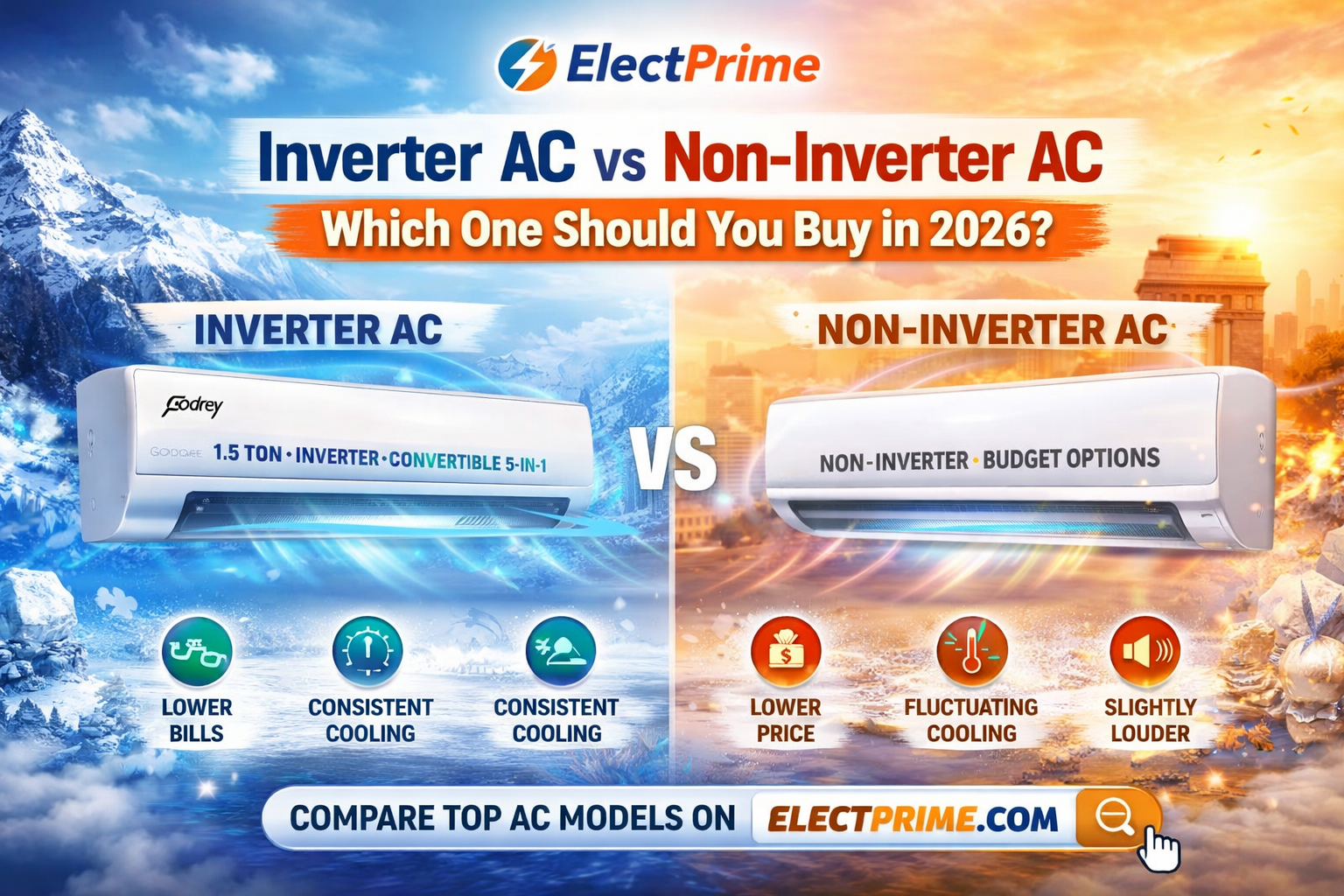
Key Differences (Simple Comparison)
Cooling Performance
- Inverter AC: Stable and smooth cooling
- Non-Inverter AC: Temperature fluctuations
Electricity Consumption
- Inverter AC: Lower for long usage
- Non-Inverter AC: Higher overall
Noise Level
- Inverter AC: Quieter
- Non-Inverter AC: Slightly louder
Price
- Inverter AC: Higher upfront
- Non-Inverter AC: Budget-friendly
Which One Saves More Electricity?
This depends on usage.
As explained in energy-saving resources by
U.S. Department of Energy, variable-speed systems (like inverter ACs) are more efficient when running for longer periods.
Practical Insight:
- 2–3 hours/day → Minimal difference
- 6–8 hours/day → Inverter AC saves significantly
👉 Explore energy-efficient models:
➡️ View Inverter AC Collection
When Should You Buy an Inverter AC?
Choose an inverter AC if:
- You use AC daily
- Usage is more than 4–5 hours
- You want lower electricity bills
👉 Best options:
➡️ Whirlpool 2 Ton Inverter AC
➡️ Godrej 1.5 Ton Convertible AC
When is a Non-Inverter AC a Better Choice?
Non-inverter AC is suitable if:
- You have a limited budget
- Usage is occasional
- You need a basic cooling solution
Cost Comparison (Short vs Long Term)
Initial Cost
- Inverter AC → Higher
- Non-Inverter AC → Lower
Long-Term Cost
- Inverter AC → Saves money
- Non-Inverter AC → Higher electricity bills
👉 Over time, inverter AC becomes more cost-effective.
Common Myths About Inverter ACs
Myth 1: Inverter AC always saves electricity
✔️ Truth: Only for long usage
Myth 2: Inverter AC cools faster
✔️ Truth: Cooling depends on capacity
Myth 3: Non-Inverter AC is outdated
✔️ Truth: Still useful for limited use
Best Options You Can Consider
For Daily Use
➡️ Godrej 1.5 Ton Inverter AC
For Large Rooms
➡️ Whirlpool 2 Ton Inverter AC
Explore More
➡️ Browse All Air Conditioners
Expert Recommendation
Most experts recommend:
✔️ Inverter AC for regular use
✔️ Non-Inverter AC for occasional use
Final Verdict
- Daily usage → Inverter AC
- Occasional usage → Non-Inverter AC
- Long-term savings → Inverter AC
Conclusion
Choosing between inverter and non-inverter AC depends on your usage pattern.
For better efficiency, comfort, and long-term savings, inverter AC is generally the smarter choice.
FAQs
Q1. Is inverter AC worth it in India?
Yes, especially for daily usage.
Q2. Which AC saves more electricity?
Inverter AC (for long usage).
Q3. Should I buy inverter or non-inverter?
Choose based on usage and budget.